
Note: This article was originally published on LinkedIn.
The New Reality: From Stream to Tsunami
We are no longer living in an era where security updates are a manageable “stream” of maintenance. We are in the middle of a climate shift.
When you see vendors like Mozilla moving Firefox to a weekly release cycle and tech giants like Oracle introducing monthly “Critical Security Patch Updates,” you are witnessing the operational fallout of a broken system.
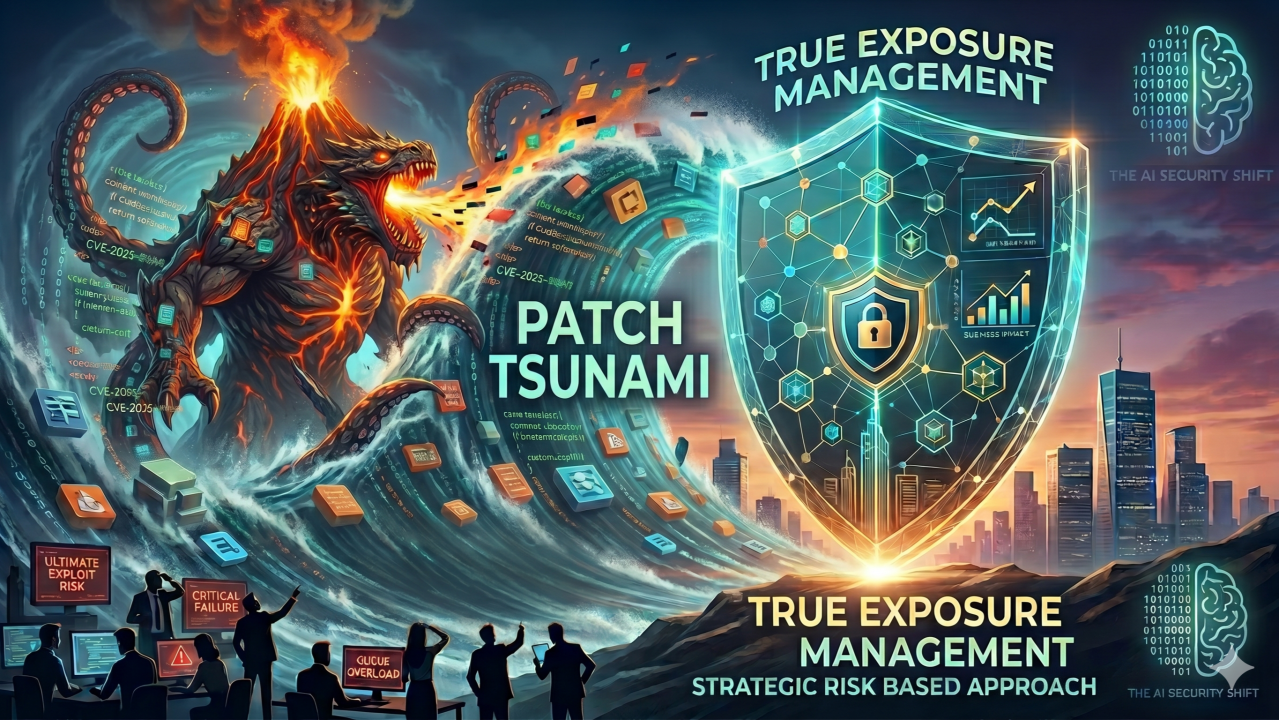
While shorter browser cycles were historically driven by the commercial pressure to ship features faster, Mozilla’s shift to a weekly cadence for Firefox is now heavily accelerated by the sheer volume of vulnerabilities being surfaced. Tech giants are reaching the same conclusion. In their April 2026 announcement, Oracle explicitly stated that the integration of frontier AI models has fundamentally altered the landscape, accelerating the pace of vulnerability detection to unprecedented levels. Whether it is software vendors using advanced AI to audit their own systems, or attackers leveraging the exact same models to weaponize exploits, the development and patch cycle has broken wide open. The pace of technology has accelerated, but our ability to validate and secure it manually is lagging. We aren’t just seeing more updates; we are witnessing the emergence of a Patch Tsunami.
The Vulnerability Apocalypse: AI-Driven Discovery
The catalyst for this tsunami is the Vulnerability Apocalypse.
We have entered a world where AI helps both attackers and defenders find vulnerabilities at a speed and scale previously unimaginable. Google’s recent identification of a zero-day exploit likely crafted by AI is the canary in the coal mine. However, we must be pragmatic: this technology is currently noisy. Recent reports of AI tools flagging vulnerabilities in curl showed an 80% false-positive rate. Skeptics might see this as proof that AI is unreliable. In my view, they are missing the bigger picture. Granted, for open-source maintainers like Daniel Stenberg, the creator of curl, this flood of AI-generated reports is a direct route to burnout because teams waste days filtering out the noise. However, the fact that the remaining 20% contains legitimate vulnerabilities that human auditors missed is exactly the point.
We must also realize that curl has a relatively small codebase. On top of that, it has been heavily used in the past to train AI vulnerability code scanners, meaning you can safely assume that a vast amount of historical flaws has already been patched. If AI tools can still extract a 20% success rate from a highly optimized, heavily scrutinized, and AI-trained codebase, imagine what they will uncover in average enterprise software.
Furthermore, this crisis isn’t limited to proprietary software. Consider the Linux kernel: in just one month, researchers identified and fixed multiple critical bugs that had persisted unnoticed for years. This shatters the long-held myth that open-source code is inherently more secure simply because of the “many eyes” on it. It proves that human auditing has strict limits. More importantly, it signals a massive warning for proprietary software, because if AI can uncover deep-seated flaws in a highly scrutinized, open-source environment, the volume of hidden vulnerabilities in closed-source enterprise applications must be staggering.
“AI is forcing decades’ worth of accumulated security debt to be paid all at once, generating a massive influx of legitimate patches that maintainers and vendors must release in weeks rather than years.”
This is where the apocalypse truly links to the tsunami: it is a brutal compression of time. The “Vulnerability Apocalypse” isn’t just about AI creating a relentless signal-to-noise crisis; it’s about AI accelerating the discovery lifecycle to a speed that human operational structures were never built to handle.
Meanwhile, the “Vibe Coding” phenomenon, where AI generates applications from prompts without architectural oversight, is producing software with 2.74x more security flaws than human-written code. We are building faster, but we are building thinner and more fragile systems.
The Operational Response Crisis
If you are still trying to patch “everything,” you are fighting a losing battle. The Patch Tsunami is forcing IT and security teams into a state of permanent, reactive chaos.
Look at Microsoft’s recent cycles, which have shown record-breaking volumes of vulnerabilities reported and fixed in a single month. If you are an enterprise IT manager, you cannot scale your human workforce fast enough to keep up with these monthly and weekly demands.
This is the operational breaking point. When the effort to maintain security consumes the entire security team, you have no bandwidth left to actually improve your security posture.
The Advisor’s Solution: Exposure Management
You cannot patch your way out of an apocalypse. You have to change the game. It is time to shift from Vulnerability Management (which is purely reactive) to Exposure Management (which is strategic).
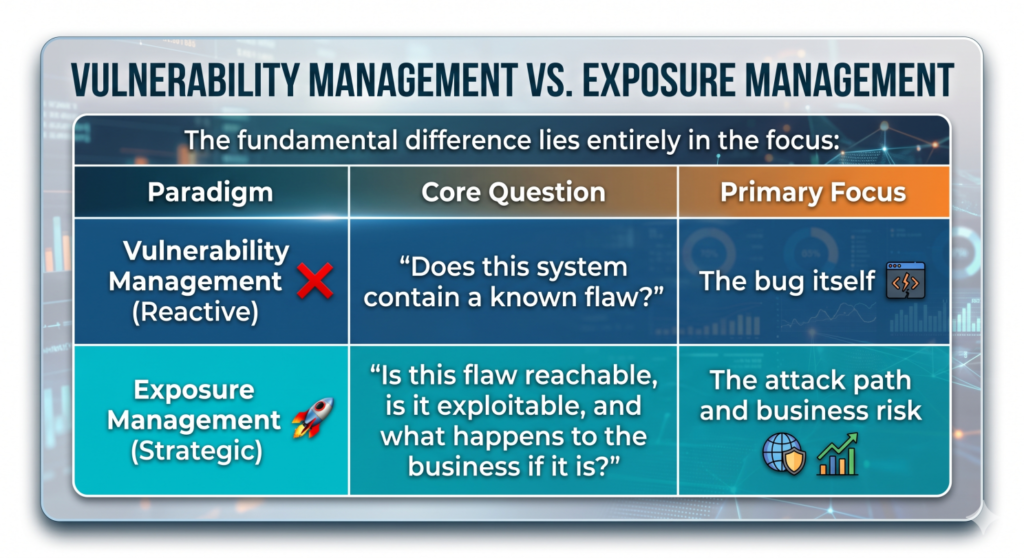
To survive the tide and transition to true Exposure Management, you must shift your execution in three ways:
- Stop chasing the count: Stop measuring success by how many patches you’ve deployed. That’s a vanity metric.
- Start measuring risk: Exposure Management asks: What is the business impact if this vulnerability is exploited? If a high-criticality bug exists on an isolated system with no data and no network path, it is not your highest priority. If a medium-severity bug exists on your core payment gateway, it is.
- Embrace Automation: You cannot manually manage this complexity. To survive the tide, you must embrace automated, risk-based patching tools that can continuously map network paths, calculate exploitability, and automatically remediate the low-level “noise.” By automating the predictable patches based on real-time risk data, you free up your human intelligence to focus on complex, high-exposure architectural flaws.
Are You Building a Strategy, or Fighting a Tide?
The Patch Tsunami is here to stay. AI will only continue to discover vulnerabilities faster, while simultaneously accelerating exploit development for those very flaws. This rapid weaponization forces vendors into a non-stop cycle of emergency releases, exponentially increasing the sheer volume of patches you are expected to deploy.
The question is no longer “How do we patch faster?” The question is “How do we manage our exposure so that the tsunami doesn’t drown the business?”
If you’re ready to stop fighting the tide and start building a strategy, it’s time to move toward true Exposure Management.
References
- Forbes (March 2026): Vibe Coding Has A Massive Security Problem
- Tweakers (May 2026): Firefox krijgt vanaf nu elke week een update
- Tweakers (May 2026): Google ontdekt zerodayexploit die waarschijnlijk met behulp van AI is gemaakt
- Oracle (April 2026): Accelerating Vulnerability Detection and Response at Oracle
- Ivanti: The Patch Apocalypse: Why Traditional Vulnerability Management is Breaking Under AI-Driven Discovery
- Tweakers (May 2026): AI-securitytool Mythos claimt 5 kwetsbaarheden in curl, maar 4 zijn onterecht
- Tweakers (May 2026): Onderzoekers vinden derde vergelijkbare Linux-kernelbug in maand tijd